Thursday, March 14, 2013

3 Workout Blogs I Love

I love to work out, but I’m not an expert on creating workout routines and schedules. I can run, stretch, and do some basic exercises on my own, but that’s about it. From there, I rely on the wonderful online community of fitness bloggers. When I want to do a workout for my arms, I search online for a routine. But there are thousands of workouts online, and not all of them are great—so I look to a few sites in specific.

Cassey Ho - Blogilates
1. Blogilates—If you haven’t heard of Cassey Ho, you need to visit her site RIGHT NOW! This fitness guru is incredibly personable and knowledgeable. She posts regularly on her blog, and her website has everything from grocery lists and recipes to workout videos and workout calendars. She even has her own shop full of adorable workout clothing, which she regularly sports for fans. Her workout videos are serious, but she keeps the mood light with cheerful conversation, encouragement, and good music.
Katrina and Karena - Tone It Up!


2. Tone It Up!—Karena and Katrina have a fantastic website. Members of their website can create their own profiles and connect with other women working toward a healthy and fit lifestyle. They’re also on Facebook and Twitter, and have published a workout DVD. And of course, they have a Tone It Up Nutritional plan and new workouts posted to their site every week.


Tatianna - LovingFit
3. LovingFit—This blog is run by Tatianna, who is an ex-professional figure skater. The website includes information on how to create a personalized workout plan and how to categorize yourself—beginner, intermediate, or advanced. She regularly posts workout routines for different muscle groups, and posts food challenges and recipes.

There are some other fantastic workout blogs out there, too. Which ones do you use as your go-to sites? I’d love to hear about your favorite blogs and inspirational fitness figures. Share with me in the comments section, and I’ll be sure to check them out!

Tuesday, March 12, 2013

High Heels: The Price We Pay for Fashion


High heels are pretty, but our feet pay the price
Image: Shutterstock
One of my favorite shows to watch with my girlfriends during college was Sex and the City. All us girls would get together, grab a bottle of wine and some chocolate, and sit down for a few laughs at the crazy lives and misfortunes of all the show’s main characters. Like so many other viewers, sometimes we’d gush over Carrie’s fashionable getups and other times we’d shake our heads and groan in horror.

What IS she wearing?

She’s got the black bra on under a sheer white shirt again!

I want that dress!

But one thing we never booed were actress Sarah Jessica Parker’s choice of footwear. We’d ooh and aah at her signature heels, more often than not Manolo Blahniks. We’d stare in disbelief as she ran down the streets in heels, never seeming to feel the pain I always associate with them.

We’d say things like, Oh my God! How can she run in those? I can’t believe she didn’t just fall down!

Sarah Jessica Parker's high heeled days are (mostly) over
Image: Featureflash / Shutterstock.com
For Parker’s six seasons and two movies playing Carrie Bradshaw, she literally lived in heels. After a decade of doing so, her feet got fed up. She slipped and twisted her ankle a few times while filming I Don’t Know How She Does It wearing cheap heels in 2011, and after a visit to the doctor, she’s had to mostly give up a life where she’s three inches taller than normal.

“I went to a foot doctor and he said, ‘Your foot does things it shouldn’t be able to do. That bone there… You’ve created that bone. It doesn’t belong there,’” Parker said.

“The moral of the story is, the chickens are coming home to roost. It’s sad, because my feet took me all over the world, but eventually they were like, ‘You know what, we are really tired, can you just stop—and don’t put cheap shoes on us?’”

For one of the world’s biggest high heels icons, the diagnosis must be tough. But it’s not any different than the ones millions of women put themselves at risk for by constantly putting themselves through Foot Hell. There’s a reason heels hurt when you’re not used to them—it’s because they do unnatural things to your feet, things that shouldn’t be done all day, every day.
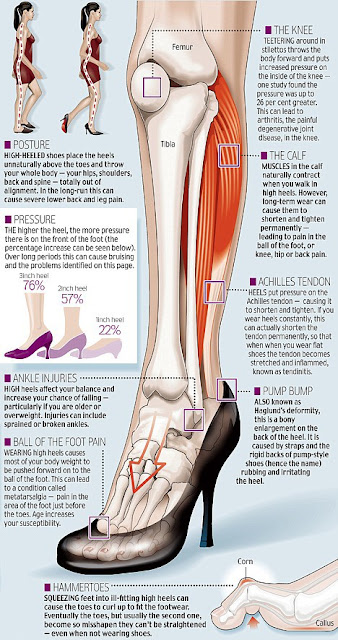
I’m all for wearing heels for special occasions. I love the way they look, and there’s just a dressed-up feel that you simply can’t get with flats. But I try to keep my heel-wearing to special occasions only, since they do a number of bad things to your body over time:

High heels put extra pressure on parts of our bodies that weren't meant to take it. This can cause serious foot damage.
Heels can damage our toes, feet, ankles, legs, and knees
  1. The Patella (inside of the knee) has up to 26% excess force placed on it when women wear heels. This is a common location in women for osteoarthritis.
  2. Posture is worse when wearing heels because the spine and hips are placed out of alignment when body mass shifts forward. The pressure on the pad of the foot goes up by 22% for 1-inch heels, 57% for 2-inch heels, and 76% for 3-inch heels.
  3. Heels make our calf muscles contract, which over time can mean those muscles become shorter and tighter.
  4. Wearing heels too much can result in Morton’s Neuroma, which is a thickening of the tissue on a nerve between the third and fourth toes. This can cause numbness or pain in the toes.
  5. The Achilles tendon is tightened and shortened by wearing heels, and over time this can cause pain in the heel of the foot.
  6. Bunions can occur when heels are too tight fitting around the pad and toes of the foot. A bony growth can form on the joint around the base of the big toe, forcing it to angle inwards and causing foot pain.
  7. Another bony growth is called Haglund’s deformity. This can happen at the back of the heel and is from rubbing from straps or the back of the shoe.
  8. Hammertoes happen when we wear those fashionable pointy-toed heels. Our toes are forced together in a bent position, and over time toe muscles weaken and become unable to straighten the toes.
  9. Metatarsalgia happens when we get pain in the ball of the foot from wearing heels for long periods of time.
  10. Don’t forget about ankle injuries that happen when we twist our ankles or fall like Sarah Jessica Parker did. Damage can be permanent, depending on how serious the fall is.

The moral of the story for those of us who haven’t ruined our feet quite yet? Save the heels for special occasions. Make it a rare treat. Don’t torture your feet, or you’ll likely spend years paying for it. 

Friday, March 8, 2013

Recognizing Anorexia Nervosa


I read an article today that made me incredibly sad. It was about a six-year-old little girl named Sophie, who developed anorexia in kindergarten. Kindergarten. She started restricting her portions of food more and more, exercised compulsively on the monkey bars, and even began throwing away her lunch and snacks at school.

And because the beginning stages of anorexia nervosa are not immediately physically apparent, no one knew. “She was slim, but not skeletal,” recalls her mother.

Be kind to your body. You'll only have one.
One night, Sophie told her mother about her problem, telling her, “Mommy, I have a problem… I am hungry all the time and I can’t eat. A voice in my head is telling me not to eat.” She was diagnosed with anorexia nervosa in the first grade, after not gaining weight for ten months straight and dropping from the 60th percentile to the 19th percentile for her weight.

Sophie is eight now, and is doing well. Her parents got her treatment from a specialty center and continually monitor her eating at home and school. Sophie was also diagnosed with mild obsessive-compulsive disorder and anxiety.

I’ve always thought of anorexia as a mostly society driven problem; I knew that there was a psychological component to eating disorders, but I never realized that sometimes they can manifest without the individual even really understanding what’s going on. Sophie, at six, didn’t know why she felt she couldn’t eat.

Many people believe that eating disorders are a choice for individuals… but the truth is, I think it’s less of a choice than we realize. Anorexics can realize what’s going on, can fear for their life, can see that what they’re doing to themselves is wrong—but they can’t always stop doing it. And as a society, I think we could be a lot better at understanding that and being more supportive to those who suffer from eating disorders.

The girl with the eating disorder is often the last to know she is ill.
Becoming the new feminine ideal requires just the right combination of insecurity, exercise and anorexia.
According to the National Institute of Mental Health, over 10 million Americans suffer from eating disorders, which have the highest mortality rate of any other psychiatric illness. But despite this, the thinspiration movement continues to grow online, promoting eating disorders as a way of life.

Anorexia isn’t always immediately visible to us, especially at the beginning. Many individuals who suffer from anorexia may never look like that skeletal image we hold in our minds, but that doesn’t mean it’s not there. Here are some of the behavioral signs and symptoms of anorexia:

  • Obsession with food, weight, calories, dieting, or exercise
  • Constant anxiety of gaining weight or being fat even when healthy or losing weight
  • Refusal to eat with or around others
  • Extremely self critical, anxious, depressed, or irritable. Is a perfectionist
  • Self worth is determined by appearance and weight, loss of desire to engage in social relationships or activities
"You are imperfect, permanently and inevitably flawed.
And you are beautiful."
Image from Tumblr.com
I am certainly someone that values eating healthy, exercising, and generally being aware of overall health—but I hope that I’ve never given the impression that thinner is better, no matter the cost. Because it isn’t. We were all made differently, and more important than being “thin” or “skinny” is being healthy and happy.

Love yourself. Love your body—and be nice to it. You only get one.

Monday, March 4, 2013

5 Common Headaches


We’ve all likely had headaches in our lives. They come in different forms and can be caused by a wide array of things. One-time occurrences are common, but so too are recurring headaches. It’s important to recognize different types of headaches and what’s causing them so you can minimize the chance you’ll get another one as well as determine proper treatment.
Headache types by location
Image from ufandshands.org

Let’s start with the common, self-induced hangover headache. Doctors aren’t positive what exactly causes hangover headaches. Alcohol can cause blood vessels to become inflamed and dehydrates us, both common causes of headaches. Circumstances like staying up late and missing out on morning caffeine can also be contributors. Drinking extra water while drinking, before bed, and after waking up can help reduce hangover headaches. Over the counter painkillers can also be used.

Tension headaches are also common and are characterized by their “behind the eyes” location. If your headaches just behind your eyes or forehead, it’s likely a tension headache and can be treated using over the counter products. Likely causes of these headaches are eyestrain, bad lighting or fluorescent lights. They are generally mild.

Massage can treat and prevent migraines
Image: Shutterstock
If your headache is just behind one eye or much more severe, it could be a migraine. Migraines are triggered by a number of things, including common food additives, caffeine, aspartame, sulfites, tannins, nitrites, alcohol, hidden additives (Tyramine or Phenylethylamine), and even leftovers (higher levels of Tyramine). Non-food causes can include stress, sleep deprivation, dehydration, fluorescent or bright lighting, and more. Migraines are often treated using prescription medication, though massage therapy is also a viable method for prevention.

Cluster headaches and migraines share many symptoms, but cluster headaches are unique in that they usually awaken someone from sleep. The also often last for a much shorter period of time—15 minutes to 3 hours—than migraines do (they can go on for days). Like migraines, prevention is key for cluster headaches and regular pain medications won’t have an effect. Treatments can include inhaling oxygen through a mask, local anesthetics, and prescription medications.

Cause or cure?
Image from memegenerator.net
Caffeine headaches can be brutal if you’re used to ingesting a lot of caffeine. They are most common in the morning and can be a catch-22 for the sufferer. While an occasional cup of coffee to cure the headache can help, doing so more than twice a week may call for additional treatment. Caffeine can also be a cause of headache, so be careful not to get caught in this cycle.
Google