 |
High heels are pretty, but our feet pay the price
Image: Shutterstock
|
|
One of my favorite shows to watch with my girlfriends during
college was Sex and the City. All us
girls would get together, grab a bottle of wine and some chocolate, and sit
down for a few laughs at the crazy lives and misfortunes of all the show’s main
characters. Like so many other viewers, sometimes we’d gush over Carrie’s
fashionable getups and other times we’d shake our heads and groan in horror.
What IS she wearing?
She’s got the black
bra on under a sheer white shirt again!
I want that dress!
But one thing we never
booed were actress Sarah Jessica Parker’s choice of footwear. We’d ooh and aah at her signature heels, more often than not Manolo Blahniks.
We’d stare in disbelief as she ran down the streets in heels, never seeming to
feel the pain I always associate with them.
We’d say things like, Oh
my God! How can she run in those? I can’t believe she didn’t just fall down!
“I went to a foot doctor and he said, ‘Your foot does things
it shouldn’t be able to do. That bone there… You’ve created that bone. It
doesn’t belong there,’” Parker said.
“The moral of the story is, the chickens are coming home to
roost. It’s sad, because my feet took me all over the world, but eventually
they were like, ‘You know what, we are really tired, can you just stop—and
don’t put cheap shoes on us?’”
For one of the world’s biggest high heels icons, the
diagnosis must be tough. But it’s not any different than the ones millions of
women put themselves at risk for by constantly putting themselves through Foot
Hell. There’s a reason heels hurt when you’re not used to them—it’s because
they do unnatural things to your feet, things that shouldn’t be done all day,
every day.
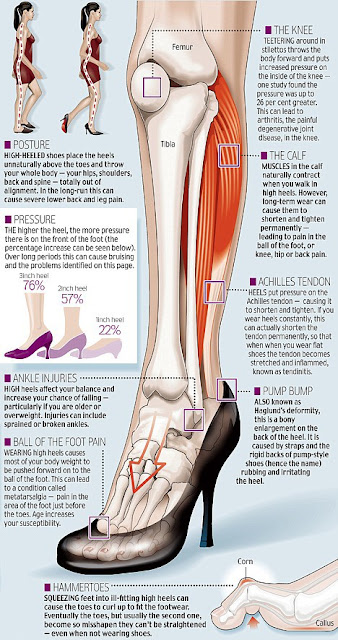 |
| Heels can damage our toes, feet, ankles, legs, and knees |
- The Patella (inside of the knee) has up to 26% excess force
placed on it when women wear heels. This is a common location in women for
osteoarthritis.
- Posture is worse when wearing heels because the spine and
hips are placed out of alignment when body mass shifts forward. The pressure on
the pad of the foot goes up by 22% for 1-inch heels, 57% for 2-inch heels, and
76% for 3-inch heels.
- Heels make our calf muscles contract, which over time can
mean those muscles become shorter and tighter.
- Wearing heels too much can result in Morton’s Neuroma, which
is a thickening of the tissue on a nerve between the third and fourth toes. This
can cause numbness or pain in the toes.
- The Achilles tendon is tightened and shortened by wearing
heels, and over time this can cause pain in the heel of the foot.
- Bunions can occur when heels are too tight fitting around
the pad and toes of the foot. A bony growth can form on the joint around the
base of the big toe, forcing it to angle inwards and causing foot pain.
- Another bony growth is called Haglund’s deformity. This can
happen at the back of the heel and is from rubbing from straps or the back of
the shoe.
- Hammertoes happen when we wear those fashionable pointy-toed
heels. Our toes are forced together in a bent position, and over time toe
muscles weaken and become unable to straighten the toes.
- Metatarsalgia happens when we get pain in the ball of the
foot from wearing heels for long periods of time.
- Don’t forget about ankle injuries that happen when we twist
our ankles or fall like Sarah Jessica Parker did. Damage can be permanent,
depending on how serious the fall is.
The moral of the story for those of us who haven’t ruined
our feet quite yet? Save the heels for special occasions. Make it a rare treat.
Don’t torture your feet, or you’ll likely spend years paying for it.


